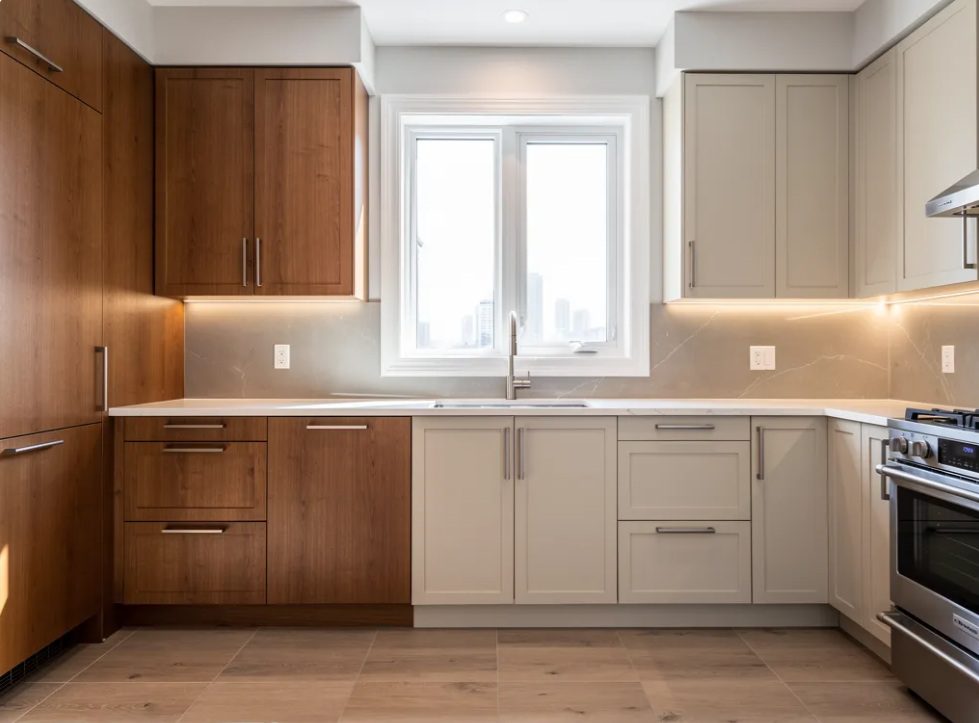
Choosing between custom and prefabricated cabinets is one of the first decisions homeowners face when planning a kitchen renovation in Toronto. Each option brings different costs, timelines, and design possibilities, and the right choice depends on the kitchen’s layout, the budget, and how long you plan to stay in the home. This guide breaks down the practical differences so you can compare quotes with confidence.
Custom Cabinets vs Prefab Cabinets: What Sets Them Apart
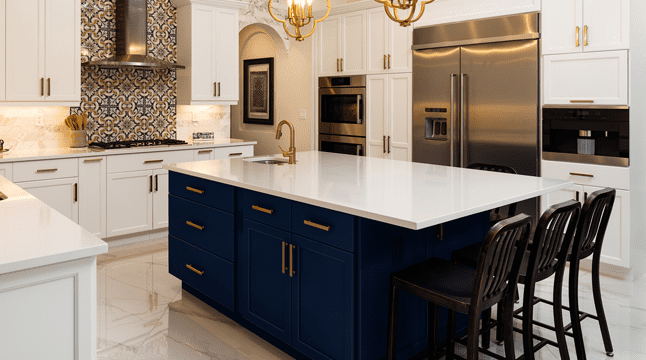
Custom kitchen cabinets are built to the exact measurements of a specific kitchen. A cabinetmaker designs each box, door, and drawer around the room’s dimensions, which makes custom cabinetry well suited to irregular layouts, sloped ceilings, or a homeowner’s specific storage requirements. Materials, finishes, and hardware are selected individually, which extends production time compared with ordering from a catalogue.
Prefabricated kitchen cabinets, often called stock cabinets, are manufactured in standard sizes and widths. They are typically available faster and at a lower starting price because they are produced in volume. Within the prefab category, there are meaningful differences worth understanding:
- Stock cabinets come pre-built in fixed sizes with limited finish and configuration choices
- Ready-to-assemble (RTA) cabinets ship flat-packed and are assembled on site or by the homeowner, usually at the lowest price point
- Semi-custom cabinets start from standard cabinet boxes but allow modifications to dimensions, finishes, or interior features, offering a middle ground between stock and fully custom work
Comparing Cabinet Costs for a Toronto Kitchen Renovation
Cabinet cost comparisons are not as simple as “custom is expensive, prefab is cheap.” Upfront pricing reflects several factors: the materials specified, the complexity of the kitchen layout, the amount of custom millwork required, and local labor rates for installation. Prefab cabinets generally carry a lower sticker price because standardized manufacturing reduces production costs, while custom cabinetry involves one-off fabrication that takes more time and skilled labor.
Installation complexity also affects total project cost. A kitchen with irregular walls or non-standard dimensions may need extra adjustment work for prefab cabinets to fit properly, which can narrow the price gap between the two options. Because every kitchen and every supplier’s pricing structure is different, the most reliable way to understand your own kitchen renovation cost in Toronto is to request itemized quotes rather than relying on general price ranges.
Durability, Materials, and Long-Term Maintenance
Durability comes down to the materials, hardware, and construction methods used, not simply whether a cabinet is labelled “custom” or “prefab.” A well-built prefab cabinet with solid-wood face frames and quality drawer slides can outperform a custom cabinet built with lower-grade materials. When comparing options, look closely at:
- Box construction (plywood versus particleboard)
- Drawer slide and hinge quality
- Finish type and how it holds up to moisture and daily use
- Warranty coverage on hardware and finishes
Repair and replacement considerations differ too. Custom cabinets can often be repaired or refaced individually since each piece is unique to the kitchen, while replacing a single damaged stock cabinet is usually straightforward as long as the same model or finish is still available.
Design Flexibility and Storage Efficiency
Standard cabinet dimensions work well in square, symmetrical kitchens, but they can leave gaps, awkward fillers, or unused corners in irregular layouts. Custom cabinetry is built around the available space, which generally allows more efficient use of every corner and wall. Semi-custom cabinetry can close much of that gap by adjusting standard boxes to better match the room.
When comparing storage efficiency, consider:
- How deep corner cabinets and pantry spaces will actually be usable
- Whether appliance openings and islands fit without filler panels
- Whether drawer and shelf configurations match how you actually store cookware and food
Choosing Cabinets for Toronto Kitchens, Condos, and Older Homes
Many Toronto kitchens, particularly in condos and older homes, present layout challenges that influence cabinetry choice. Condo kitchens often need to maximize storage within a small footprint, while century homes frequently have uneven walls, sloped ceilings, or non-standard room dimensions that standard cabinet boxes do not always accommodate cleanly.
Accurate measurements and professional installation matter regardless of which option you choose. A cabinet that is off by even a few millimeters in a tight galley kitchen can affect door clearance, appliance fit, and workflow. Balancing your renovation budget with the functionality and appearance you want is easier once you understand how your specific layout affects the decision between custom, semi-custom, and prefab options.
Urban Reno Design’s kitchen renovation services in Toronto include custom cabinetry and kitchen layout planning alongside countertop installation, kitchen islands, flooring, lighting, backsplashes, and plumbing fixture upgrades, so cabinetry decisions are made as part of the full renovation plan rather than in isolation.
Comparing Quotations Before You Decide
Once you have narrowed down your options, comparing quotes properly is one of the most useful steps in the process. Ask each contractor or supplier to break down:
- The specific materials and finishes included
- Hardware brand and warranty terms
- What installation work is included versus billed separately
- Whether design consultation, measuring, and layout planning are part of the quote
A detailed, itemized quote makes it far easier to compare custom, semi-custom, and prefab options on equal terms rather than by price alone.
Neither custom nor prefab cabinetry is the universally “better” choice. The right option depends on your kitchen dimensions, your renovation budget, how much personalization you need, the material quality you are comparing, and how long you plan to prioritize the space’s function and appearance. Semi-custom cabinetry often gives Toronto homeowners a practical middle path when a layout needs some adjustment, but a fully custom build isn’t necessary.
If you are planning a kitchen renovation in Toronto and want guidance on which cabinetry option fits your layout and budget, Urban Reno Design can walk through the trade-offs as part of a full kitchen design consultation. Reach out at 647 677 8759.
Conclusion
Neither custom nor prefab cabinetry is the universally “better” choice. The right option depends on your kitchen’s dimensions, your renovation budget, how much personalization you need, the material quality you are comparing, and how long you plan to prioritize the space’s function and appearance. Semi-custom cabinetry often gives Toronto homeowners a practical middle path when a layout needs some adjustment but a fully custom build isn’t necessary.
If you are planning a kitchen renovation in Toronto and want guidance on which cabinetry option fits your layout and budget, Urban Reno Design can walk through the trade-offs as part of a full kitchen design consultation. Reach out to us at urbanrenodesign@gmail.com to start planning your renovation.
Frequently Asked Questions (FAQs)
Are custom kitchen cabinets worth the investment compared to prefab?
It depends on your kitchen and priorities. Custom cabinets make sense when a layout is irregular, storage needs are specific, or you want full control over materials and finishes. If your kitchen has standard dimensions and you want to manage costs, a well-made prefab or semi-custom option can deliver strong value without the longer production timeline custom work requires.
Are prefabricated cabinets less durable than custom cabinets?
Not necessarily. Durability depends on the materials, hardware, and construction quality used, not simply whether a cabinet is custom-built. A prefab cabinet with solid box construction and quality drawer slides can outlast a custom cabinet made with lower-grade materials, so it is worth comparing specifications rather than assuming custom automatically means longer-lasting.
How does cabinet installation differ between custom and prefab options?
Prefab cabinets, especially ready-to-assemble units, are generally quicker to install since they arrive in standard sizes. Custom cabinets are built to the kitchen’s exact measurements, which usually means a longer production period but a more precise fit on installation day. Irregular walls or layouts can add installation time and cost to either option.
What are the best cabinet options for a small Toronto kitchen or condo?
Small Toronto kitchens and condos benefit from cabinetry that maximizes every inch without crowding the floor space. Semi-custom or fully custom cabinets can be designed around a compact footprint, while quality prefab options may also work well if the room’s dimensions are close to standard. The right choice depends on your specific layout and storage priorities.
Do custom cabinets add more value to a home than prefab cabinets?
Well-designed, well-built cabinetry of either type can support a home’s overall appeal, but there is no guaranteed resale return tied specifically to custom versus prefab. Buyers generally respond to visible quality, functional layout, and good condition rather than the manufacturing method alone, so material and construction quality matter more than the label.
How should I budget for cabinets for kitchen renovation?
Start by requesting itemized quotes that separate materials, hardware, finishes, and installation labor so you can compare options on equal terms. Semi-custom cabinetry often provides a practical middle ground between stock pricing and fully custom costs. Working with a renovation contractor who plans cabinetry alongside the rest of the kitchen design also helps avoid budget surprises.